

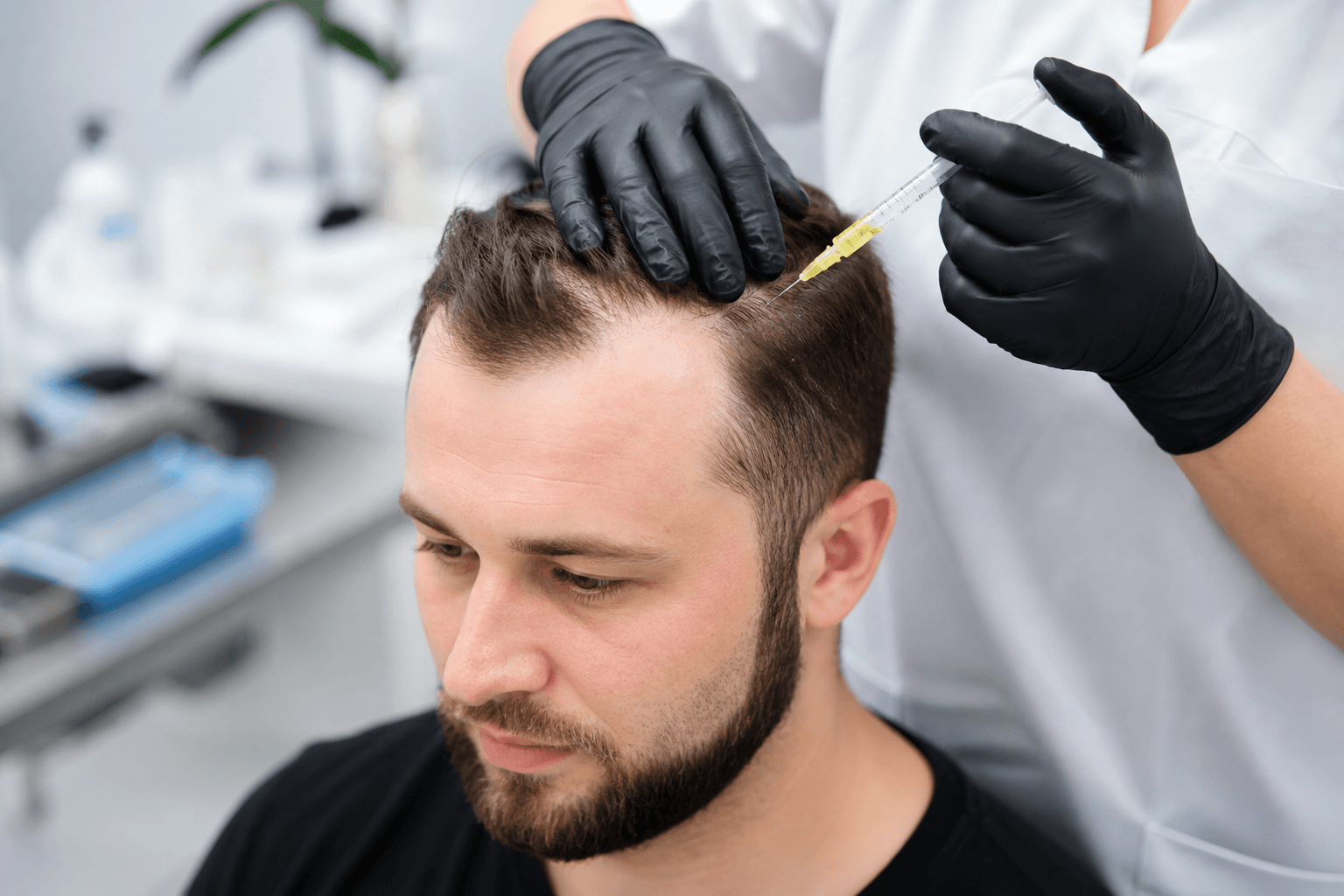
Hair thinning has a way of sneaking up on you. One day your hair feels full and easy to style, and the next you notice more scalp showing or extra strands left behind in the shower. It is no surprise that more people are turning to PRP hair restoration as a natural, non-surgical way to support hair regrowth.
If you are exploring PRP hair restoration in Louisville, KY, one of the first questions you are likely asking is simple: how many sessions will it actually take to see results? The answer is not one-size-fits-all, but there are clear guidelines that can help you understand what to expect and how to plan your treatment journey.
This article was updated May 2026 to reflect the latest treatment approaches and patient expectations.
Before diving into session counts, it helps to understand what PRP hair restoration actually does. PRP stands for platelet-rich plasma, which is derived from your own blood. After processing, this concentrated plasma is injected into the scalp to stimulate hair follicles, improve circulation, and support healthier hair growth cycles.
Unlike quick-fix solutions, PRP works with your body over time. That means consistency and proper scheduling play a major role in your results.
Most patients begin with a series of three to four PRP sessions as their initial treatment plan. These sessions are typically spaced out over a few months to give the scalp time to respond and regenerate between treatments.
For many individuals, this initial series is enough to:
However, it is important to understand that PRP is not a one-time treatment. Think of it more like a long-term investment in your hair health rather than a single appointment fix.
After completing the initial series, patients often transition into a maintenance phase. This usually involves:
Some patients may need slightly more frequent sessions early on, especially if hair thinning is more advanced.
Timing is everything when it comes to PRP hair restoration. Treatments are typically scheduled about 4 to 6 weeks apart during the initial phase.
This spacing allows:
It might be tempting to schedule sessions closer together in hopes of faster results, but that approach rarely works. Hair growth follows a biological timeline, and giving your body time between treatments leads to better, more sustainable outcomes.
Absolutely. One of the most important things to understand about PRP hair restoration is that results are highly individualized.
Several variables can impact how many sessions you may need, including:
Stage of hair loss
Early thinning often responds faster than long-standing hair loss.
Age and overall health
Your body’s ability to heal and regenerate plays a role in how effective PRP can be.
Hormonal factors
Conditions like androgenic alopecia may require ongoing maintenance.
Consistency with treatments
Skipping sessions or delaying appointments can slow progress.
Lifestyle habits
Stress, nutrition, and scalp care all influence results.
Two patients in Louisville receiving PRP hair restoration could follow the same treatment schedule and still see different timelines for improvement. That is why a personalized consultation is key to setting realistic expectations.
Once you complete your first round of PRP sessions, you may start noticing changes such as reduced shedding, improved texture, and gradual thickening.
Hair growth is ongoing, and so is hair loss. To maintain your results, most patients continue with periodic PRP sessions.
Typical maintenance includes:
Patience is part of the process. While some patients notice reduced shedding within the first couple of months, visible hair growth often takes 3 to 6 months or longer.
Full results tend to develop gradually over time, especially when treatments are maintained consistently.
Louisville patients are increasingly choosing PRP hair restoration because it offers a natural approach without surgery or significant downtime.
For individuals who want a subtle, progressive improvement rather than a dramatic overnight change, PRP is an appealing option.
One of the biggest misconceptions about PRP hair restoration is expecting instant or dramatic results after a single session. In reality, this treatment is about building momentum over time.
Patients who commit to the full treatment plan and follow recommended scheduling tend to see the most satisfying outcomes.
Most patients begin to see noticeable improvements after three to four sessions, though full results may take several months to develop.
PRP is not permanent, but results can be long-lasting with proper maintenance treatments scheduled throughout the year.
PRP tends to be more effective in the earlier stages of hair thinning. Advanced hair loss may require additional or alternative approaches.
There is minimal downtime. Most patients return to normal activities the same day, with only mild scalp sensitivity.
The best way to determine candidacy is through a consultation, where your hair loss pattern, health history, and goals can be evaluated.
Yes, PRP is often part of a broader hair restoration plan and may be combined with other therapies depending on your needs.
PRP hair restoration is not about quick fixes or overnight transformations. It is about giving your hair follicles the support they need to function at their best over time.
For most patients in Louisville, KY, that means starting with a series of three to four sessions, spacing them properly, and continuing with maintenance treatments to protect and enhance results.
If you are willing to stay consistent and patient, PRP can be a powerful step toward fuller, healthier-looking hair that feels like your own again.






.png)
.png)

















.png)


















.jpg)


